Extreme Debris Disks Reveal Catastrophic Planetary Collisions in Young Star Systems
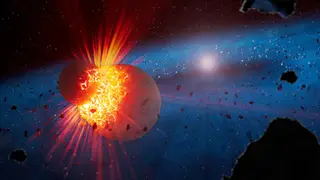
Analysis of 21 extreme debris disks orbiting young stars provides evidence that intense impacts between large planetary bodies generate the unusual dust clouds observed around these systems. The dust composition, featuring abundant silica and crystalline silicates, matches patterns predicted from vaporization and rapid condensation during massive collisions similar to those that formed Earth's Moon. These findings illuminate how planetary systems evolve through dramatic collision events during their early stages of development.
Researchers examined infrared data from 21 young star systems displaying unusually intense dust clouds, using both the James Webb Space Telescope and its predecessor, the Spitzer observatory. The analysis marks the first comprehensive survey of this particular class of debris disks. What distinguishes these systems is the size and composition of their dust particles—much finer than typical planet-forming disks and enriched with silica compounds that form under extreme heat.
The study connects observations of distant stellar nurseries to terrestrial planetary history. About 38 percent of the examined systems showed silica-rich compositions, suggesting high-energy collisions between Mars-sized objects. Older systems displayed different dust signatures, potentially indicating gravitational upheaval among already-formed planets rather than initial assembly collisions. These variations provide astronomers with markers to identify which evolutionary stage a young system occupies.
Understanding planetary formation mechanisms has implications for exoplanet research and long-term assessments of habitability around distant stars. The findings could refine models used to predict which young stellar systems may eventually harbor stable, potentially life-supporting planets. While these observations address fundamental questions in astronomy rather than immediate practical applications, they contribute to comprehensive knowledge of planetary system architecture—information that may eventually inform strategies for detecting Earth-like worlds elsewhere in the galaxy.