Google DeepMind's Gemini 4 Argon Promises Advanced AI Capabilities for Clinical Systems
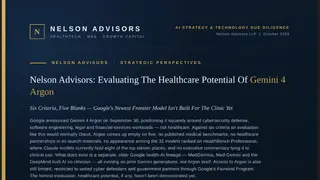
Google DeepMind released Gemini 4 Argon on September 30, 2026, an artificial intelligence system designed to address systemic challenges in healthcare including legacy system vulnerabilities, cybersecurity threats, and fragmented diagnostic processes. The model features expanded computational capacity with a 1-million token output limit, multimodal perception, and autonomous capabilities for biomedical research and software security remediation. These architectural improvements aim to reduce errors from iterative workflows and provide sustained reasoning for complex medical and enterprise knowledge tasks.
Gemini 4 Argon addresses longstanding constraints that have limited previous AI applications in medicine. Earlier systems required multiple sequential prompts to handle complex tasks, causing information loss and reasoning degradation as context shifted between exchanges. The new model's architectural design enables single-pass processing of massive datasets—patient histories spanning years, comprehensive clinical literature, and entire software systems—without fragmentation. This continuous reasoning capability directly targets fragmentation problems endemic to modern healthcare infrastructure, where legacy systems, security vulnerabilities, and disconnected diagnostic workflows create both clinical and operational friction.
If successfully deployed, Gemini 4 Argon could meaningfully impact healthcare delivery by reducing diagnostic delays through simultaneous multimodal analysis and accelerating the modernization of vulnerable hospital infrastructure. Healthcare institutions relying on outdated systems may benefit from autonomous software remediation capabilities. However, actual clinical utility depends on rigorous validation, regulatory clearance, and careful integration into existing workflows. Broader impacts remain contingent on implementation outcomes and whether the system's theoretical capabilities translate to measurable improvements in patient outcomes and system security in real-world hospital environments.