Developer Successfully Executes Classic Doom Game Entirely Within SQL Database
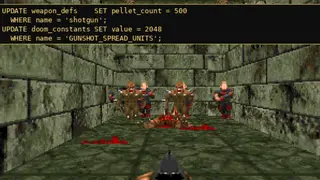
A database architect has created SQLDoom, a fully functional implementation of the 1993 game Doom that runs entirely within CedarDB, a PostgreSQL-compatible database system. The project uses 5,900 lines of SQL for game logic alongside a Python frontend for graphics rendering and sound, achieving 60 FPS performance with multiplayer capability. The approach leverages the relational structure of Doom's original data format to simplify conversion into database tables.
The SQLDoom project represents an evolution of earlier database-based game experiments, building upon Vogel's previous DoomQL implementation. The architecture cleverly separates concerns: Python handles the presentation layer for graphics, audio, and user input, while CedarDB processes all computational logic. This division allows the system to maintain 60 frames per second despite running game calculations within a relational database, using techniques like binary space partitioning expressed as ordered table queries.
The conversion process benefited from Doom's inherently relational data structure. Vogel only needed 1,000 lines of Python to transform the game's WAD package data into database tables, and the SQL implementation actually shortened the original 9,000-line C codebase to 5,900 lines, largely due to SQL's ability to update multiple entities simultaneously with single statements rather than iterative loops.
While primarily a technical novelty, SQLDoom could influence database education by making abstract SQL concepts more tangible through an interactive, engaging application. Developers might explore whether similar approaches could optimize other computationally intensive systems where relational data naturally fits. However, the project's practical impact may remain limited to demonstrating design possibilities rather than offering performance advantages in real-world scenarios where specialized architectures typically outperform general-purpose databases.