India's Electronics Manufacturing Services Sector Surges on Policy Support and Advanced Demand
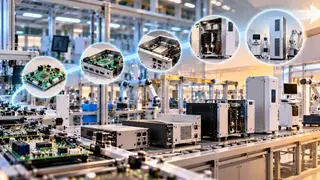
India's electronics manufacturing services industry has grown from USD 10-12 billion in fiscal 2019-20 to USD 40-45 billion in fiscal 2024-25, driven by government initiatives and rising demand from defence, aerospace, AI and clean energy sectors. Though India represents only 5-6 percent of the global EMS market, expansion is expected to accelerate beyond USD 150 billion by fiscal 2029-30 as companies pursue China diversification strategies. Domestically produced semiconductors under the India Semiconductor Mission are projected to strengthen the entire EMS ecosystem.
India's electronics manufacturing sector has undergone a dramatic transformation, expanding nearly fourfold in just five years as multinational corporations increasingly relocate production away from China. The government has catalyzed this growth through targeted incentive programs spanning mobile devices, telecommunications infrastructure, and automotive components, while simultaneously building foundational capacity in semiconductor design and fabrication through dedicated mission initiatives.
The competitive advantage emerging in India's EMS market stems from a fundamental shift in how manufacturing partners create value. Rather than competing primarily on production volume and cost, Indian firms are investing in engineering expertise, quality certifications, and systems integration capabilities to handle sophisticated applications in defence, aerospace, and industrial sectors. This transition toward complex, specialized manufacturing promises higher profit margins and stronger long-term client relationships compared to commodity-based assembly work.
India's EMS expansion could reshape global electronics supply chains by offering multinational manufacturers a viable alternative to concentrated Asian production, potentially reducing geopolitical risks. For India's economy, sustained growth in this sector may generate skilled employment and technology transfer opportunities while strengthening domestic semiconductor independence. However, success depends on companies maintaining quality standards and innovation rates to compete globally, and on continued government policy consistency in a shifting political landscape.