Indian Wind Sector Accelerates with Hybrid Projects and Manufacturing Expansion
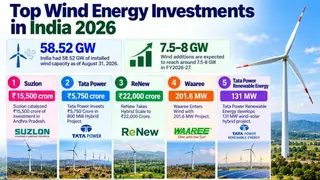
India's wind energy capacity reached 58.52 GW as of August 2026, with developers like Suzlon and Tata Power leading expansion into wind-solar hybrids and battery storage systems. Andhra Pradesh has emerged as a major investment hub, attracting over ₹30,000 crore through projects combining turbine manufacturing with grid infrastructure development. Annual wind additions are projected to reach 7.5-8 GW in the coming fiscal year, representing approximately ₹52,500-56,000 crore in investment opportunity.
India's wind energy sector is undergoing a structural shift toward integrated projects that combine multiple generation sources with storage capabilities. The addition of 2.43 GW during the first five months of fiscal 2026-27 positions the sector for sustained growth, with developers increasingly viewing wind projects not as isolated assets but as components within broader renewable ecosystems. This evolution reflects changing grid demands and the need for dispatchable power that can meet peak consumption windows.
Andhra Pradesh's emergence as a major investment corridor demonstrates how state-level policy alignment with private development can create multiplier effects beyond energy generation alone. The concentration of manufacturing, project development, transmission infrastructure, and employment opportunities in a single geography creates economic resilience and attracts sustained capital flows. Major developers like Suzlon, Tata Power, and ReNew are leveraging this environment to scale operations efficiently.
The sector's expansion could significantly advance India's renewable energy targets while creating employment across manufacturing, construction, and operations. However, the model's success depends on grid infrastructure keeping pace with generation capacity—transmission bottlenecks could constrain returns. For consumers and policymakers, the shift toward hybrid projects with storage may help stabilize electricity supply and reduce price volatility. Supply chain localization through manufacturing investments could strengthen energy security and reduce import dependency over time.