Five Nations Dominate Mobile Data Usage as 5G Drives Record Consumption Levels
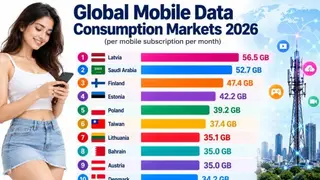
Latvia, Saudi Arabia, Finland, and Estonia have become the world's heaviest consumers of mobile data, with Latvia leading at 56.5 GB per subscription monthly. The surge is driven by widespread 5G adoption, unlimited data plans, and fixed wireless access services that enable significantly higher usage rates. Major telecom operators across these regions are investing heavily in network capacity to handle the rapidly increasing traffic demands.
The data rankings reveal a clear pattern: countries offering competitive unlimited mobile plans alongside robust 5G infrastructure are seeing dramatically higher per-subscriber consumption. Latvia's achievement is particularly notable given that data-only subscriptions there average 236 GB monthly, indicating fixed wireless access is becoming a significant network traffic contributor alongside traditional smartphone usage. This trend extends across diverse markets—from the Nordic region to the Middle East—suggesting that affordability combined with network capability drives behavioral change.
Telecom operators in these high-consumption markets are monetizing the surge effectively. For instance, data services now comprise substantial revenue portions for major carriers, while aggressive pricing strategies (such as €15.99 unlimited plans in Latvia) appear to accelerate adoption rather than cannibalizing profits. The expansion reflects a global shift toward viewing mobile data as essential infrastructure rather than a premium service.
Rising mobile data consumption could reshape internet access patterns, particularly benefiting populations in regions where fixed broadband infrastructure remains limited. Operators' heavy capacity investments may improve service quality but could also accelerate digital divides if pricing strategies vary significantly by market. Consumers in high-consumption nations may gain faster access to cloud services and streaming content, while network operators face ongoing pressure to balance affordability with infrastructure costs. Regulatory bodies may need to monitor competitive dynamics to ensure market sustainability.