Discovery of Four-Winged Dinosaur Suggests Independent Evolution of Flight Capabilities
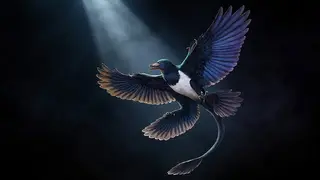
A newly identified four-winged dinosaur species called Norellraptor barsboldi from China indicates that flight adaptations may have evolved separately in different dinosaur lineages rather than being inherited from a common ancestor. The small predator, measuring 57 centimeters, displays detailed feather preservation that allows researchers to examine how microraptor species and early birds developed similar aerial characteristics through distinct evolutionary pathways. This finding clarifies long-standing questions about whether these groups' flight features represent convergent evolution or shared ancestry.
The Norellraptor barsboldi specimen offers paleontologists a rare opportunity to study flight evolution with exceptional clarity. Researchers determined the dinosaur was at least three years old at death, providing a mature example for comparison—crucial since bone structure changes significantly during growth. This mature specimen allowed scientists to conduct detailed microscopic analysis of its skeletal structure, particularly the forearm bones that inform understanding of wing mechanics.
The research identified roughly 194 distinct evolutionary modifications across microraptorine species. Notably, approximately 30 percent of traits defining microraptorines emerged independently along avian evolutionary lines, including stronger forelimbs, modified rib and breastbone structures, and specialized thumb feathers. These parallel developments suggest different evolutionary solutions to similar functional demands rather than shared ancestral inheritance.
This discovery may reshape how paleontologists and evolutionary biologists teach the origins of flight, potentially affecting museum exhibits and educational curricula. The findings could influence broader scientific understanding of how natural selection produces similar solutions across unrelated lineages—a principle with applications beyond paleontology. Researchers studying modern animal adaptation and evolutionary mechanisms might find the convergent evolution patterns relevant to their work.