Ancient mammal with continuously replaced teeth challenges textbook understanding of mammalian evolution
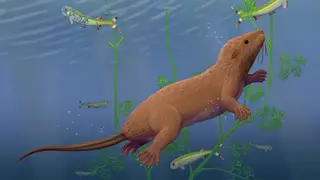
A 120-million-year-old fossil discovered in China reveals an ancient semi-aquatic mammal with an unusual combination of features including platypus-like feet and reptilian tooth replacement throughout its lifetime. This discovery contradicts the long-held biological principle that mammals replace their teeth only once or twice during their lives. The finding provides new insights into early mammal evolution and the diversity of dental structures in prehistoric mammals.
The fossil of Dongoconodon platycauda was discovered in 2018 in northeastern China and subsequently examined by paleontologists at Yunnan University. The creature, which inhabited Earth during the early Cretaceous period alongside dinosaurs, was a relatively small animal weighing roughly 190 grams. Its anatomy suggests it was well-adapted to aquatic life, with physical characteristics resembling modern water-dwelling mammals and specialized skeletal features indicating extensive webbing between its digits.
The discovery's significance lies in its dental structure, which fundamentally contradicts established biological understanding maintained in scientific literature for over a century. Rather than the two sets of teeth typical of modern mammals, this ancient species possessed teeth across all four categories—incisors, canines, premolars, and molars—that underwent multiple replacement cycles throughout its lifetime, a trait previously thought exclusive to reptiles.
This discovery may influence how paleontologists and evolutionary biologists approach understanding early mammalian development and diversity. Textbooks used in educational institutions could require updates to reflect more nuanced views of dental evolution. The finding might encourage researchers to reconsider assumptions about how major anatomical features evolved independently rather than as interconnected systems, potentially reshaping graduate-level paleontology curricula and broadening perspectives on evolutionary flexibility during the Cretaceous period.