Advanced Cosmological Models Reveal Links Between Primordial Galaxies and Modern Stellar Chemistry
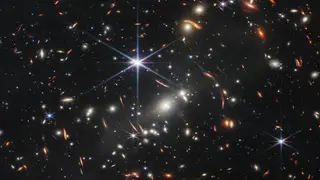
Researchers from an international collaboration used the MEGATRON simulation project to model the early Universe with unprecedented detail, tracking how the first stars and galaxies formed within the first few hundred million years after the Big Bang. The simulations incorporated sophisticated models of radiation, chemistry, and galaxy formation to understand how ancient stellar populations shaped the interstellar medium over cosmic time. The findings establish connections between observations of distant young galaxies and the chemical composition of the oldest stars currently visible in the Milky Way.
The MEGATRON simulation suite represents a collaborative effort spanning multiple international institutions, with operations running from 2023 through 2030. The research integrates computational models tracking gas dynamics, radiation transport, and elemental composition changes across cosmic timescales. By simulating galaxy evolution from the Universe's earliest moments through billions of years of development, researchers can trace how the first massive stars dispersed newly created elements into surrounding space.
This work addresses a fundamental observational challenge: the earliest galaxies remain too distant and faint for direct telescopic study of individual ancient stars. The simulations bridge this gap by connecting what the James Webb Space Telescope observes in the distant early Universe with measurable chemical compositions found in the Milky Way's oldest known stellar populations, creating a testable framework linking two otherwise separate astronomical datasets.
These findings could strengthen our understanding of cosmic chemical evolution, potentially informing models used in exoplanet research and the search for habitable worlds. The results may also influence how astronomers prioritize observations with powerful telescopes and allocate resources for future space missions. For the broader scientific community, validated simulations of early galaxy formation could advance theoretical frameworks underlying astrophysics education and cosmological research agendas across institutions worldwide.