Particle Collider Detects Anomaly Suggesting Critical Point in Primordial Matter Formation
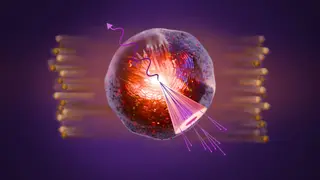
Researchers at Brookhaven National Laboratory's Relativistic Heavy Ion Collider smashed gold nuclei together to recreate conditions milliseconds after the Big Bang and detected an unexpected variation pattern in ejected particles. The anomaly appears as a dip in particle fluctuations at specific collision energies, potentially indicating a long-sought critical point where nuclear matter fundamentally changes its transformation behavior. While the signal is statistically significant, physicists emphasize that additional confirmation is needed before confirming this breakthrough about how primordial quark-gluon plasma solidified into ordinary matter.
Researchers at Brookhaven's facility collided gold nuclei at extremely high speeds to generate conditions mimicking the universe's first moments. The experiment measured how forcefully particles were ejected from these collisions across varying energy levels. Rather than observing the expected gradual shift in particle behavior, scientists identified an unexpected dip—a temporary reduction in fluctuations at particular energies that suggests a fundamental phase transition in how matter transforms under extreme conditions.
The findings contribute to understanding nuclear matter's "equation of state," a comprehensive set of physical laws governing how pressure, temperature, and density interact. This rulebook becomes critical when studying extreme environments like neutron star cores. While the detected signal carries statistical weight, the research team acknowledged that confirmation through additional experiments remains necessary before declaring definitive discovery of this theorized critical point.
If confirmed through further research, this discovery could advance fundamental physics understanding of matter's behavior under extreme conditions, with potential applications in astrophysics and neutron star modeling. The work may also refine theoretical predictions about the early universe's composition and evolution. However, the broader public impact would likely remain primarily within scientific and academic communities, influencing theoretical frameworks rather than producing immediate practical technologies or widespread societal effects.