Webb Space Telescope Reveals Hidden Stars and Protostars Within Dusty Stellar Nursery
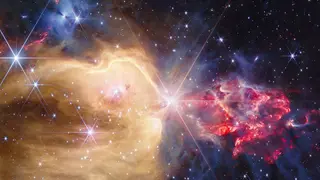
The James Webb Space Telescope has imaged NGC 7129, a stellar nursery located 3,300 light-years away, revealing previously obscured young stars and protostars embedded within clouds of dust and gas. Webb's infrared sensitivity allows astronomers to penetrate the dusty cocoons that typically hide these forming stars from observation by other telescopes. The observations provide detailed views of the early stages of stellar formation and the jets of gas being ejected by the developing stars.
The James Webb Space Telescope's infrared capabilities represent a significant advancement in observational astronomy. Unlike previous instruments that cannot penetrate dust clouds, Webb's design allows researchers to detect heat signatures from forming stars buried within stellar nurseries. This technological advantage has opened new windows into understanding how stars develop from their earliest stages, when they remain completely hidden from conventional telescopes.
NGC 7129 exemplifies the dynamic processes occurring in stellar formation regions. The central star LkH(alpha) 234, a massive pre-main-sequence star several times heavier than our Sun, actively shapes its environment through powerful outflows that carve cavities in surrounding gas clouds. These same outflows both disperse material and compress it, paradoxically creating environments where additional stars can form, demonstrating the complex interconnections within stellar nurseries.
Webb's observations of stellar nurseries could enhance fundamental understanding of star formation processes applicable across the cosmos. This knowledge may inform models predicting planetary system development and habitability. The discoveries could also influence long-term space exploration strategies by clarifying how star systems typically form. For academic institutions and researchers, such findings may drive increased interest and funding in astrophysics. Broader public engagement with astronomy could follow from these visually striking images of cosmic processes.