Quarks create measurable waves in primordial quark-gluon plasma at Large Hadron Collider
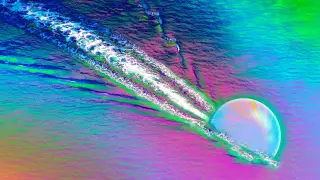
Scientists at CERN's Large Hadron Collider observed direct evidence that quarks moving through quark-gluon plasma generate waves and wakes, demonstrating that this ancient matter behaves as a unified fluid rather than disconnected particles. By tracking individual quarks traversing the plasma created in heavy ion collisions, researchers detected ripples and swirling patterns analogous to a duck moving through water. The findings provide unprecedented insight into the physical properties of the scorching matter that filled the universe microseconds after the Big Bang.
Researchers at CERN recreate the extreme conditions of the early universe by smashing heavy ions together at nearly light speed, briefly producing quark-gluon plasma before it rapidly cools. This primordial state of matter existed only microseconds after the Big Bang before quarks and gluons combined into the particles that form ordinary matter today. By developing new detection methods to identify signatures of quark movement through this plasma, scientists can now measure specific characteristics like wake size, propagation speed, and dissipation time.
These measurements of quark-generated disturbances offer a window into understanding fundamental properties of the plasma that filled the newborn universe. The technique opens pathways for analyzing additional collision data to build a more complete picture of how this ancient matter behaved and responded to particle movement.
These findings could enhance fundamental physics knowledge about matter under extreme conditions, potentially informing theoretical models of the universe's origins. The research may also have indirect applications in understanding quantum chromodynamics and particle behavior. While the work is primarily theoretical, advances in detecting and measuring plasma properties could eventually influence how scientists design future particle physics experiments and interpret high-energy collision data.