Creative Renovation Merges Historic Architectural Details With Modern Function in Compact French Home
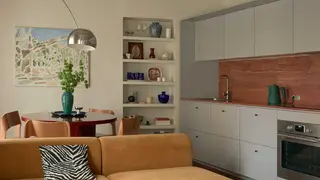
A 484-square-foot apartment in Nice, France was transformed by removing an interior wall to create an open kitchen and living area that serves as the home's central gathering space. The owners installed a custom IKEA kitchen spanning the entire wall length, paired with a red travertine countertop and backsplash sourced directly from an Italian quarry. The renovation preserved the apartment's original early 20th-century frescoes and hexagonal terracotta tiles while incorporating vintage furnishings and iconic European design elements.
The apartment's transformation centered on a structural modification that fundamentally altered how the family inhabits the space. By eliminating an interior partition, the owners created a unified zone where cooking, dining, and relaxation converge into a single multipurpose area—a layout strategy increasingly common in contemporary small-space design. The travertine sourced from an Italian quarry represents a deliberate choice to source premium materials despite budget constraints, illustrating how targeted investment in key surfaces can elevate modest square footage.
The renovation demonstrates how preservation and modernization need not conflict. The owners maintained the building's original decorative elements—early 20th-century frescoes and terracotta flooring—while introducing contemporary systems and furnishings, creating temporal layering within the compact footprint. This approach reflects the designers' professional expertise in balancing historical integrity with livable functionality for a growing household.
This renovation may influence how small-space dwellers in historic urban centers approach renovation priorities, particularly regarding open-plan layouts and material investment. The project could encourage homeowners to view structural changes and premium finishes as worthwhile in compact properties, potentially affecting renovation budgets and contractor demand. Additionally, the emphasis on blending vintage finds with contemporary design may reinforce consumer interest in secondhand and artisanal markets as stylistic alternatives to mass production, affecting retail patterns in home furnishings and design sectors.