Ceramist Creates Personalized Hudson Valley Retreat Inspired by Modern and Vintage Design
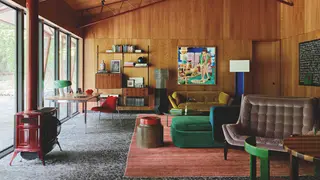
Renowned ceramist Sunshine Thacker designed and built her home in a woodland clearing near New York's Hudson Valley, blending contemporary and nostalgic architectural elements. The residence features her own ceramic creations alongside curated furnishings, with materials including glass, iron, and wood arranged to create a cohesive living space. The home's design draws inspiration from Case Study houses and the work of architect Jean Prouvé, reflecting Thacker's vision of a warm, welcoming sanctuary.
Thacker's architectural vision draws heavily from mid-century modernist movements, particularly the California Case Study program and the innovative prefabrication methods championed by French designer Jean Prouvé. Her home employs a modular grid system finished in garnet red that structures both exterior and interior spaces, creating visual continuity while allowing for flexibility in arrangement. The cherry wood ceiling and strategic use of glass maximize natural light while maintaining the warm, intimate atmosphere Thacker envisioned.
The residence functions as a gallery for both Thacker's own ceramic work and a carefully curated collection of furnishings and artwork. Rather than treating her ceramics as standalone pieces, she integrated them throughout—from the Nuclear Option coffee table to custom tilework and sculptural panels—creating an environment where her artistic practice and daily living merge seamlessly. This approach demonstrates how a maker's home can embody their creative philosophy across multiple scales and mediums.
This profile may influence how affluent homeowners and design enthusiasts approach residential projects, potentially increasing interest in mid-century modernist references and artist-designed interiors. The story could encourage appreciation for modular, flexible design systems as practical alternatives to conventional construction. However, the narrative's focus on a high-end custom residence in an exclusive region may reinforce aspirational rather than broadly applicable design principles, potentially widening perception gaps between accessible design solutions and luxury residential possibilities.