First Microblazar Candidate Detected Pointing Particle Beam Toward Earth
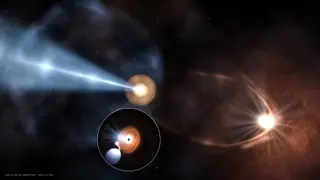
Astronomers have identified the strongest candidate yet for a microblazar, a theorized but never-before-confirmed type of cosmic object consisting of a black hole ejecting powerful jets of particles and radiation. The object, designated IRAS 18293-0941, is located within our galaxy and represents the first serious detection of this extreme phenomenon. Studying microbrazars will provide insights into how supermassive black holes behave and emit high-energy jets.
IRAS 18293-0941 represents a significant milestone in black hole research. Located roughly 12,000 light-years away within our galaxy, this binary system consists of a black hole orbiting a massive star with an 11-day cycle. Material streaming from the star toward the black hole generates two opposing jets of high-energy particles, with one directed toward our planet. The detection confirms theoretical predictions about smaller-scale versions of blazars existing in nature.
Identifying these objects poses considerable observational challenges. The evolutionary phase during which a system becomes a microblazar is extremely brief in cosmic timescales, making systematic discovery difficult. Additionally, IRAS 18293-0941 remains obscured by cosmic dust, requiring specialized instruments across multiple wavelengths to study effectively. These constraints explain why this represents the first credible identification despite decades of theoretical expectation.
This discovery may advance fundamental physics understanding by providing detailed observations of extreme gravitational phenomena. Studying microblazars could refine models of how black holes accumulate matter and generate relativistic jets, knowledge with potential applications to astrophysical theory and computational modeling. While presenting no direct threat—the jet's energy disperses across vast distances—this research could influence how scientists prioritize space observation resources and develop future detection technologies for similarly elusive cosmic objects.