Hypervelocity stars orbiting the galactic center provide unprecedented insights into our galaxy's black hole
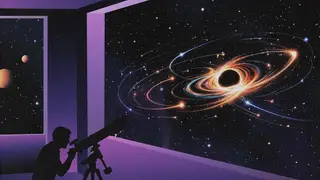
Astronomers have identified a star called S301 traveling at over 8 percent the speed of light as part of a population of extremely fast-moving stars orbiting the supermassive black hole at the center of the Milky Way. These stars should not exist according to conventional understanding, as black holes typically tear apart the gas and dust from which stars form, yet their presence and observable movements are now allowing scientists to probe the galactic center for the first time. The study of these extraordinary stellar objects promises to reveal hidden properties of the central black hole and test theories of gravity in one of the universe's most extreme environments.
The galactic center presents extraordinary observational challenges that have long hindered astronomical research. Located roughly 26,500 light-years from Earth, this region combines extreme density, intense luminosity, and thick cosmic dust into an environment that overwhelms traditional viewing methods. The central supermassive black hole, Sagittarius A*, remained undiscovered until the 1970s despite its significance, underscoring how difficult direct observation of this area has proven to be historically.
The discovery of hypervelocity stars like S301 represents a fortunate scientific development, as these objects should theoretically be impossible given the destructive gravitational forces at work. Their existence and measurable trajectories now provide astronomers with natural probes into an otherwise impenetrable cosmic environment, offering a pathway to study phenomena that conventional instruments cannot directly access.
This research may strengthen our fundamental understanding of gravitational physics and black hole behavior, potentially influencing theoretical models taught in physics education and refined in academic research. The findings could also drive technological advancement in telescope design and observational techniques to overcome current atmospheric and distance limitations. For broader society, enhanced knowledge of galactic structure and extreme physics contributes to long-term scientific literacy and may inspire future space exploration technologies, though immediate practical applications remain limited.