Egyptian Crocodile Fossil Reclassified as Early Gavialine
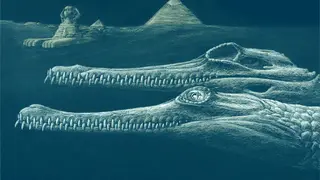
Micro-CT scans of a Middle Eocene crocodile skull from Egypt show it was not closely related to the modern false gharial, contrary to earlier assumptions. The fossil has been renamed Herugavialis cairensis and identified as an early-branching gavialine with a long, narrow snout. The study also traces Mediterranean gavialoid diversity and its later disappearance, possibly linked to the Messinian salinity crisis.
The fossil, catalogued as SMNS 10575, was first described in 1927 and comes from Middle Eocene deposits near Cairo. Researchers compared it against 152 species and 331 anatomical traits to reposition it among gavialoids. Its elongated snout accounts for roughly 64% of skull length, and its eye sockets have raised rims.
Mediterranean gavialoids show a patchy record: at least six Paleogene species and six more from the Miocene, with no known Oligocene representatives. Their decline in the Late Miocene and disappearance before the Pliocene may connect to the Messinian salinity crisis.
Revised classifications could reshape how museum collections and educators present crocodilian evolution, affecting curators, students, and science communicators. The finding may also draw public attention to Mediterranean paleoenvironments and the Messinian salinity crisis, potentially enriching exhibits and outreach. For researchers, the study's CT-based methods could encourage similar reexaminations of legacy specimens, though such work depends on funding and access to scanning facilities.