AI-Driven Network Adjustments Help Operators Cut 5G Energy Costs
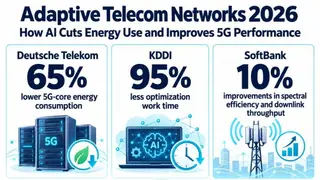
Telecom operators are using AI and software controls to adjust radio settings, computing resources, and energy use as traffic changes. Deutsche Telekom reported up to 65% lower 5G-core energy consumption in live tests, while KDDI cut optimization work time by more than 95% and SoftBank saw about 10% gains in spectral efficiency and downlink throughput. AT&T is also modernizing its radio network with Open RAN and Cloud RAN to make changes faster.
Deutsche Telekom’s live trials in February 2026 showed as much as 65% less energy use in the 5G core by matching computing and network resources to demand, with predictive AI planned later. Its shared Horizontal Telco Cloud lets network functions scale and update separately.
AT&T said in March 2026 that over half its traffic ran on open-capable hardware and over half its radio replacement was done; Cloud RAN operated in two cities, with a third-party rApp optimizing production. KDDI’s February 2026 cooperative AI cut base-station optimization labor by over 95% and improved a congestion-related metric by 25% in early areas. SoftBank’s trial showed roughly 10% average gains in spectral efficiency and downlink throughput.
These changes may lower operating costs for telecom providers, potentially supporting more stable pricing or investment in coverage, though those benefits are not guaranteed. Consumers and businesses could see fewer congestion slowdowns and more consistent 5G performance as networks tune themselves. Reduced energy use may lessen the environmental footprint of mobile infrastructure. Network engineers may shift from manual tuning to oversight roles, changing skill needs.