Simulations hint planets may form around supermassive black holes
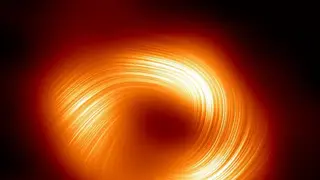
Astrophysicists Bhupendra Mishra and Wladimir Lyra presented simulations indicating that massive planets might arise in dusty disks surrounding supermassive black holes. The process could resemble how planets form around stars. The work was discussed in a SETI livestream on September 21, 2026.
The researchers behind the idea are Bhupendra Mishra and Wladimir Lyra. Their peer-reviewed study appeared in The Astrophysical Journal on June 29, 2026, and they spoke about it during a SETI Live broadcast on September 21, 2026. The scenario centers on actively feeding supermassive black holes, called active galactic nuclei, whose hot accretion disks resemble the planet-forming disks around stars.
In these simulations, planet-sized bodies could begin near Jupiter's mass and continue accumulating material. Because one active black hole might generate millions of such objects, the proposed population would be vastly larger than known exoplanet systems. The work also notes that a supermassive black hole can exceed the sun's mass by a factor of a million.
If confirmed, this idea could reshape how researchers and the public think about where planets can exist, expanding the search for worlds beyond stars. Astronomers may gain a new target class for observation, while science communicators could use it to illustrate shared physical processes across vastly different scales. It may also influence future mission and instrument priorities, though any practical effects would likely remain distant and speculative until more evidence emerges.