High-Energy Black Hole Jets Shape Star Formation in Galactic Halos
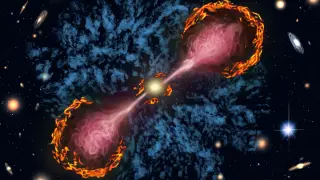
Astronomers studying radio jets from supermassive black holes found that these powerful outflows can trigger or suppress star formation in the gas envelopes surrounding galaxies. Using data from the DESI survey and LOFAR radio observations, researchers detected strong ionized hydrogen signals along jet axes, indicating the jets heat and energize surrounding gases. The findings demonstrate that black hole jets play a significant regulatory role in how galaxies evolve over cosmic time.
Supermassive black holes reside at the centers of most galaxies, including our own. When these objects actively consume material, they launch twin jets of extraordinarily energetic particles at near-light speeds. These jets extend far beyond the galaxy itself, penetrating into the surrounding gaseous envelope known as the circumgalactic medium—a vast reservoir that can dwarf the visible galaxy by ten to twenty times.
The research team analyzed hundreds of galaxies using two major observational instruments: a spectroscopic survey designed to map the universe's expansion, and a radio telescope array scanning the low-frequency sky. By detecting ionized hydrogen signatures along jet paths, they identified where jets deposit tremendous energy into surrounding gas clouds, either igniting stellar birth through compression or extinguishing it through disruption.
Understanding black hole jets' regulatory effects on galaxy evolution could refine cosmological models predicting how galaxies develop over billions of years. This knowledge may inform theories about star formation rates across the universe and help explain observed variations in galaxy types and sizes. While primarily advancing fundamental astronomy, such insights could eventually inform broader questions about our galaxy's past and future, potentially affecting long-term perspectives on cosmic evolution and humanity's place within it.