ESA's Hera spacecraft slows down for asteroid rendezvous
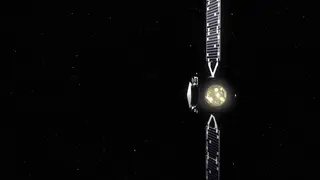
The European Space Agency's Hera mission will fire three hydrazine thrusters for 93 minutes to reduce its speed relative to the Didymos system. The maneuver is designed to prepare the spacecraft for reaching Dimorphos, the small moon that NASA's DART mission struck in 2022. If successful, Hera is expected to arrive at the asteroid next month to begin its investigations.
Hera is ESA's follow-up to NASA's 2022 DART experiment, which struck Dimorphos, the smaller body orbiting Didymos. Launched in October 2024, Hera has already made course corrections and a software update in 2026. Its next burn will aim three hydrazine thrusters at the asteroid pair and fire them for 93 minutes, cutting its relative speed by a few hundred meters per second.
After its planned November 2026 arrival, Hera will spend six months studying the impact's aftermath. It will release two cubesats: Milani for spectral surface observations and Juventas for radar soundings of the asteroid's interior. These data may clarify how DART changed Dimorphos's orbit and formed a crater, informing future planetary-defense work.
The Hera mission could shape how societies prepare for hazardous asteroids by testing whether we can understand and verify an intentional deflection. Its findings may inform engineers, policymakers, and emergency planners who assess planetary-defense options. For the public, clearer data about DART's effects could make asteroid risks and space missions more tangible. However, Hera's immediate influence may remain scientific, with any societal benefits emerging gradually as results are analyzed.