Mercury reaches its evening peak on October 12
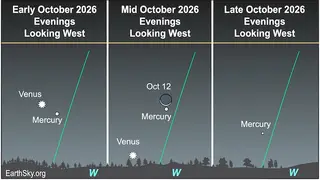
Mercury will reach greatest eastern elongation on October 12, 2026, appearing 25 degrees from the sun. Observers in the Southern Hemisphere have the best chance to see it low in the west shortly after sunset. For many Northern Hemisphere viewers, the planet will likely be too close to the horizon.
Mercury’s greatest eastern elongation on October 12, 2026, puts it 25 degrees from the sun. The peak occurs at 10 UTC, or 5 a.m. CDT and 11 p.m. New Zealand Daylight Time. Southern Hemisphere viewers have the year’s strongest evening opportunity, while many Northern Hemisphere observers may find it too near the horizon because the ecliptic sits low.
At elongation Mercury is expected to glow near magnitude -0.1, outshining most stars, and telescope users may see it roughly 60% illuminated and 6.75 arcseconds wide. It lies in Libra, whose stars twilight may obscure. Mercury then drops rapidly toward the horizon, disappears late in October, and meets inferior conjunction on November 4 at 14:00 UTC.
This event may give Southern Hemisphere skywatchers, educators, and astrophotographers a brief chance to engage with planetary science and night-sky observation. Because Mercury is often difficult to see, a favorable apparition could encourage public stargazing, planetarium talks, or classroom discussions about inner solar system geometry. Northern Hemisphere audiences may be less directly affected, though online charts and reports could still