Young Host Galaxy of Record-Setting Fast Radio Burst Points to Magnetars
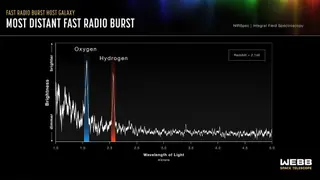
Astronomers used the James Webb Space Telescope to identify the host galaxy of FRB 20240304B, the most distant known fast radio burst, after MeerKAT pinpointed its position but optical observations found no visible object. The galaxy's spectrum indicates it existed when the universe was about 3 billion years old and that its stars formed within roughly 30 million years. This small, young host favors a magnetar origin over a neutron-star merger, which would be expected in an older galaxy.
Fast radio bursts are millisecond radio flashes, and early on they were hard to separate from Earth-based interference. Once astronomers could tell them apart, most were traced beyond the Milky Way, implying an extremely energetic, brief source. Candidate explanations include neutron-star mergers forming black holes or magnetar surface flares; more speculative options exist.
MeerKAT located FRB 20240304B precisely in 2024, yet visible-light searches saw nothing there. JWST then detected a small host galaxy. Its spectrum places it when the cosmos was roughly three billion years old, with stars mostly formed in about thirty million years. That young, compact setting favors magnetars over slow neutron-star mergers.
This finding may deepen public interest in cosmic origins and help astronomers refine models of FRB sources. It could affect observatory teams by highlighting the value of combining radio and space telescope data, and may shape future survey priorities. Educators and science communicators might use it to explain how distant galaxies reveal the lives of stars. For most people, any societal effect is likely indirect, gradual, and tied to curiosity rather than daily life.