Webb identifies source of record-setting fast radio burst in a small galaxy
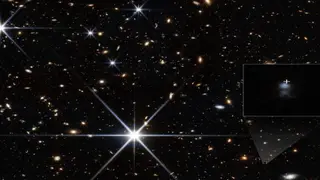
Researchers used the James Webb Space Telescope to locate the host galaxy of the most distant fast radio burst found so far. The burst, FRB 20240304B, was detected by South Africa's MeerKAT radio telescope in March 2024 and originated from a very small galaxy when the universe was about 3 billion years old. The result could help scientists better understand what causes these millisecond-long radio flashes.
Astronomers traced FRB 20240304B, first seen by South Africa's MeerKAT array in March 2024, to a compact dwarf galaxy. Webb's near-infrared spectrograph separated the galaxy's light, revealing oxygen and hydrogen features that yielded a redshift of 2.148. That value places the burst when the cosmos was roughly three billion years old.
FRBs are millisecond radio flashes, and most are not seen again, complicating efforts to identify their sources. Researchers had generally linked such events to larger, star-forming galaxies, so this faint, small host was unexpected. The finding adds a distant example to known FRB host galaxies.
This result may sharpen public interest in space science and radio astronomy, potentially increasing support for telescopes and data infrastructure. Astronomers could benefit from a clearer link between FRB host environments and burst origins, though one event cannot settle the mystery. Educators and science communicators may use the distant dwarf galaxy as an accessible example of cosmic scale and Webb's capabilities. Any societal effects would likely be gradual and indirect, tied to research funding, technology, and public engagement rather than immediate daily life.