Astronomers Spot Red Dwarf Slowly Consuming a Brown Dwarf
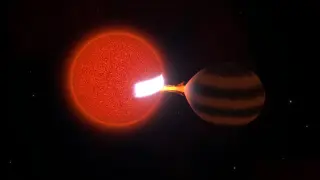
An international team led by MIT found a system about 300 light-years away where a low-mass star is gradually pulling material from a brown dwarf companion. The pair, named ZTF J0440+2325, orbits every 86.65 minutes, and the transfer is slow enough to continue for billions of years. The study, published in Nature Astronomy, is the first observed case of a low-mass star steadily feeding on another low-mass object.
The object pair, ZTF J0440+2325, sits roughly 300 light-years away in the Milky Way. Its two members complete an orbit every 86.65 minutes. Material from the brown dwarf spills toward the red dwarf and hits its surface, producing a large hot spot. This is the first known case of a low-mass star steadily taking matter from another low-mass body.
The discovery came from Zwicky Transient Facility observations at Palomar Observatory, which repeatedly images the sky to find changing light. The MIT-led team published in Nature Astronomy. The slow transfer may persist for hundreds of thousands of years, perhaps billions.
This finding may broaden public understanding of stellar evolution and planetary fate, affecting astronomy enthusiasts, educators, and researchers. It could inspire new observing programs and models of mass transfer, potentially refining how scientists interpret unusual variable signals. Because the system is distant and long-lived, immediate societal effects are likely minimal; any impact may come through education, science communication, and future astrophysics research.