ISS Astronaut Records Auroras Before Expected Geomagnetic Storm
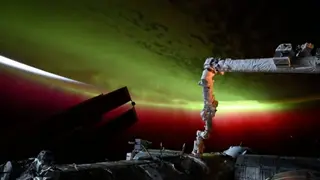
NASA astronaut Anil Menon posted video of green and red auroras seen from the International Space Station on October 10, 2026. NOAA warned that moderate geomagnetic storms could occur on October 11 because of multiple coronal mass ejections, potentially affecting technology and making auroras visible in some northern and upper Midwest U.S. states. Auroras form when charged solar particles interact with Earth’s magnetosphere and atmosphere, exciting gases that then release light.
Anil Menon, a NASA astronaut aboard the ISS, captured green and red auroral displays on October 10, 2026, and shared the footage online. The sighting came as NOAA forecast moderate geomagnetic storming for the following day, driven by several coronal mass ejections.
Those eruptions left the Sun on October 7 and 8; the later one was faster and might combine with the earlier one before reaching Earth. Solar activity from Region 4549 also raised concerns about radio and GPS signal quality. Auroras arise when solar particles excite atmospheric oxygen and nitrogen, which then emit light.
If geomagnetic activity reaches forecast levels, radio operators and GPS users could see degraded signals or added noise, while technological systems may face modest disruption. Skywatchers in northern and upper Midwest states might get rare aurora views if skies clear. The event’s broader effect may be limited but noticeable, especially for groups relying on navigation, communication, or space-based systems.