Voskhod 1: The Soviet Union's first three-person spaceflight
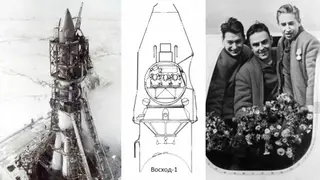
On October 12, 1964, the Soviet Union launched Voskhod 1 with three cosmonauts aboard, making it the first crewed spaceflight to carry more than one person. The cabin was too cramped for pressure suits, so the crew flew without them, and two members became the first civilians in space. The roughly day-long mission added another early milestone to the Soviet space program.
Voskhod 1 launched on Oct. 12, 1964, and orbited for slightly more than a day. It carried commander Vladimir Komarov, engineer Konstantin Feoktistov, and doctor Boris Yegorov. The engineer and doctor became the first civilians in space. Because the craft was cramped, the crew flew without pressure suits, adding risk.
The mission grew from a two-person plan after Soviet political pressure to add a third cosmonaut. The crew studied how liquids and gases behaved in microgravity and took photographs of Earth. Unlike earlier Vostok crews, they remained inside the capsule during landing. NASA’s first multi-person flight, Gemini 3, followed about six months later.
Voskhod 1 may have reinforced public fascination with human spaceflight and intensified perceptions of a technological race. Its multi-person crew could have encouraged later missions to carry specialists, while the decision to fly without suits may have highlighted safety tradeoffs. Engineers, cosmonauts, and planners might have felt pressure to balance political goals with crew survival. Broader audiences may have seen space as increasingly accessible, even as the mission’s cramped conditions showed how difficult early spaceflight remained.