ISS astronaut photographs auroras over Earth with an iPhone
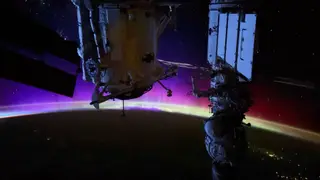
NASA astronaut Anil Menon took an iPhone image of pink, purple, and red auroras above Earth's night side from the International Space Station on Oct. 10. The display occurred during heightened geomagnetic activity after coronal mass ejections hit Earth's magnetic field, producing G1 to G3 storms. The colors largely come from nitrogen at altitudes around 60 to 120 miles (100 to 200 kilometers).
Anil Menon photographed the auroras from the ISS on Oct. 10 using an iPhone. The scene showed pink, purple, and red light over Earth's night side, with faint city lights and stars visible among the station and visiting spacecraft structures. The blue-purple tones largely came from nitrogen around 60–120 miles up, while red came from oxygen above roughly 125 miles.
The display followed coronal mass ejection impacts that sparked G1–G3 geomagnetic storms. Menon also shared video on X, describing the passage as an uncommon, absorbing experience, with reflections on the station's exterior. The image stands out because astronauts often use Nikon cameras, though smartphone astrophotography has grown, and Artemis 2 astronauts used iPhones to document their lunar flyby.
The image may broaden public engagement with space science by showing that ordinary phone cameras can capture remarkable orbital views. It could encourage amateur skywatchers and students to try night-sky photography, while phone makers may see more demand for low-light modes. It may also help NASA and astronauts share human experiences of geomagnetic activity, though it does not replace scientific instruments.