Battery Gigafactories Across Europe and U.S. Show Varied Stages of Development
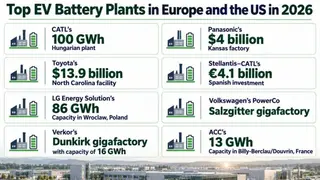
Europe and the United States are adding large EV battery plants, including CATL's planned 100 GWh site in Hungary, Panasonic's Kansas factory, Toyota's North Carolina facility, and a Stellantis-CATL project in Spain. CATL began trial cell production at its Debrecen plant in September 2026, while LG Energy Solution's Wroclaw complex already has about 86 GWh of disclosed capacity. Volkswagen's PowerCo Salzgitter factory started commissioning in late 2025 and is ramping toward an initial 20 GWh, expandable to 40 GWh.
CATL’s Debrecen site started trial cell production on 22 September 2026, but its 100 GWh target describes the finished plant, not present output. LG Energy Solution’s Wroclaw hub had roughly 86 GWh of disclosed yearly capacity as of December 2024, reflecting a more mature operating position.
Volkswagen’s Salzgitter factory began commissioning in December 2025 and is scaling toward 20 GWh, potentially 40 GWh. Stellantis and CATL’s Zaragoza venture started construction in November 2025, aims for late-2026 output, and may reach 50 GWh. Verkor’s Dunkirk plant began at 16 GWh and delivered its first fully on-site batteries by August 2026.
These factories could reshape local labor markets, offering thousands of construction and manufacturing roles while requiring new training. Nearby communities may see investment and infrastructure pressure. Automakers and consumers could benefit from more regional battery supply, potentially lowering EV costs and reducing reliance on distant supply chains. Environmental gains may depend on grid cleanliness and plant utilization.