Vanillin May Offer New Route for Chronic Wound Treatment
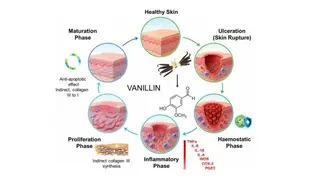
A review published in the International Journal of Pharmaceutics examines vanillin as a possible treatment for chronic wounds. The compound has shown antioxidant, anti-inflammatory, and antibacterial effects in laboratory research, including neutralizing reactive oxygen species and reducing inflammatory signals. Because vanillin can react with amino groups, it has been used to form chitosan-based gels, dressings, scaffolds, and nanoparticles, some of which improved wound closure in animal tests.
Vanillin is a widely used flavor molecule, often described as economically second among flavoring agents after saffron. It can be obtained by extracting vanilla plants, by microbial or enzymatic conversion of ferulic acid, glucose, or lignin, or by chemical synthesis from eugenol and guaiacol. In lab studies, it has shown antioxidant, anti-inflammatory, and antibacterial activity.
Its aldehyde group can bind amino groups, allowing it to crosslink chitosan from shellfish shells into gels, dressings, scaffolds, fibers, and nanoparticles. Animal experiments on infected, diabetic, or full-thickness wounds reported closure rates near 94–96% for certain formulations. Yet testing remains nonstandardized, skin penetration and clearance are poorly understood, and high doses can harm cells; skin enzymes may also convert it to vanillic acid.
Count first para: Vanillin(1) is2 a3 widely4 used5 flavor6 molecule7, often8 described9 as10 economically11 second12 among13 flavoring14 agents15 after16 saffron17. It18 can19 be20 obtained21 by22 extracting23 vanilla24 plants25, by26 microbial27 or28 enzymatic29 conversion30 of31 ferulic32 acid33, glucose34, or35 lignin36, or37 by38 chemical39 synthesis40 from41 eugenol42 and43 guaiacol44. In45 lab46 studies47, it48 has49 shown50 antioxidant51, anti-inflammatory52, and53 antibacterial54 activity55. Good.
Second: Its1 aldehyde2 group3 can4 bind5 amino6 groups7, allowing8 it9 to10 crosslink11 chitosan12 from13 shellfish14 shells15 into16 gels17, d
paragraph. Plain text. No markdown? Labeled sections. Fine. Potential issue: "Vanillin is a widely used flavor molecule, often described as economically second among flavoring agents after saffron." Source says "commonly reported to rank second only to saffron in economic importance among flavoring agents." This is close but paraphrased. Okay. "obtained by extracting vanilla plants" source says extraction of natural vanillin predominantly from plants of Vanilla genus. Fine. "microbial or enzymatic conversion of ferulic acid, glucose, or lignin" source says biotechnological production from substrates such as ferulic acid, glucose or lignin via enzymatic conversion or de novo microbial fermentation using engineered strains. We omitted engineered strains. Fine. "chemical synthesis from eugenol and guaiacol" source says petrochemical precursors including eugenol and guaiacol. Fine. "aldehyde group can bind amino groups" source says reacts readily with amino groups. Fine. "crosslink c