Ancient Elephant Tooth Reveals a Lost Pleistocene Landscape
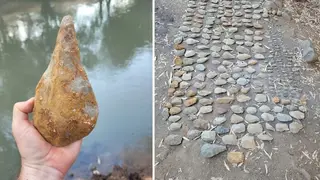
Researchers analyzed molar and tusk fragments from a straight-tusked elephant found at Gesher Benot Ya'aqov in northern Israel. Using CT scans, 3D reconstruction, microscopic wear analysis, isotope geochemistry, and pollen data, they reconstructed a Pleistocene landscape with woodlands, grasslands, marshes, rivers, and shallow water. The site also yielded Acheulian stone tools, indicating that early humans lived alongside these large mammals nearly 700,000 years ago.
The fossils belonged to Palaeoloxodon antiquus, a straight-tusked elephant and one of the Pleistocene’s largest land mammals. Excavated at Gesher Benot Ya’aqov in the Jordan Rift Valley, south of today’s Hula Valley, the molar and tusk fragments were recovered by Gonen Sharon and colleagues and later studied by Hannah Farrell’s team.
The team applied computed tomography, three-dimensional modeling, wear microscopy, isotopic chemistry, and pollen study to reconstruct a mosaic of woodlands, grasslands, marshes, rivers, and shallow water. Carbon isotopes suggest reliable water; pollen points to reeds, sedges, willows, tamarisks, and aquatic plants. Nearby Acheulian basalt handaxes and cleavers place early humans in the same setting, possibly within a stable Levantine Corridor refuge.
This research may deepen public understanding of human origins and Pleistocene ecology, potentially enriching museum exhibits, education, and heritage tourism around Gesher Benot Ya’aqov. It could also encourage archaeologists and local communities to value wetland landscapes as archives of past climate and migration. Because interpretations rest on multiple evidence