Fossil Jaw Marks Point to Small Dromaeosaur Scavenging a Tyrannosaur Carcass
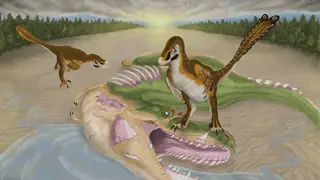
A fossilized skull of a juvenile Albertosaurus from Alberta's Horseshoe Canyon Formation bears tooth marks on its lower jaw. Researchers compared mark spacing with known dinosaur teeth and concluded a small dromaeosaurid, most likely Atrociraptor marshalli, made them. The estimated 16–18 kg predator probably scavenged the much larger tyrannosaur's carcass rather than hunted it, according to a study in the Journal of Paleontology.
The fossil came from the Horseshoe Canyon Formation, a roughly 70-million-year-old rock unit exposed along Alberta's Red Deer River. The animal was not fully grown, measuring about 6 meters long and weighing an estimated 533 kilograms.
Two distinct mark sets appear on its lower jaw: three parallel grooves on the splenial, plus a single surangular mark containing roughly 28 evenly spaced serrations. Since a tooth pulled at an angle leaves marks closer together than the true tooth spacing, the researchers applied a trigonometric correction before comparing possible makers.
The study may gently reshape how the public pictures tyrannosaurs — not as untouchable apex predators, but as animals whose carcasses could become food for smaller hunters. Museum visitors and science communicators could gain a more layered view of ancient food webs, while fossil enthusiasts may appreciate how tooth-mark spacing can identify a culprit. It could also draw attention to Alberta's fossil heritage and the small raptors that shared those ecosystems.