Museum Specimen Yields New Small Carnivorous Dinosaur from Cretaceous Britain
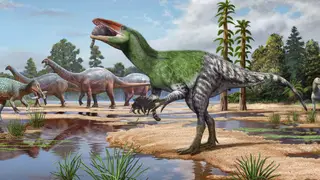
Researchers have described Invictibellatrix amberina, a new megaraptoran dinosaur based on a braincase kept for about a century at the Natural History Museum in London. The fossil came from Early Cretaceous deposits on the Isle of Wight and is the first megaraptoran known from Europe. Estimated at 3–4 m long and roughly 1.5 m tall, it was a relatively small feathered predator that likely hunted small dinosaurs, lizards, and mammals.
The braincase was acquired by the Natural History Museum in London in May 1924 from Rev. R. W. Hooley, having been collected at Sudmoor Point near Brook on the Isle of Wight. It comes from Barremian strata of the Wessex Formation and had never been formally described until now.
Comparisons with Timurlengia, a small tyrannosauroid, suggest Invictibellatrix amberina was modest in size — perhaps among the smallest megaraptorans known, since other members of the group reached 6–10 m and over 2,000 kg. Researchers propose the lineage originated in Asia and reached Europe roughly 130 million years ago.
The description may draw renewed public attention to museum collections, where overlooked specimens can still yield significant discoveries. For paleontologists, it could strengthen arguments that megaraptoran origins and dispersal are more complex than previously assumed, potentially prompting reexamination of similar fossils in European institutions. Museum visitors and amateur fossil hunters on the Isle of Wight may find the story especially engaging, though the scientific impact will depend on how the findings withstand further scrutiny.