Ericsson posts 6% Q3 sales growth on mobile networks and IPR licensing
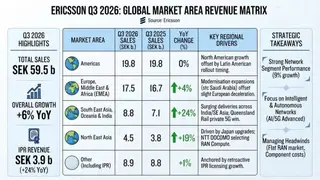
Ericsson’s Q3 2026 net sales reached SEK 59.5 billion, up 6% from SEK 56.2 billion in the same quarter last year. Mobile Networks revenue rose 9% to SEK 38.7 billion, and IPR revenue climbed 24% to SEK 3.9 billion. Reported net income dropped to SEK 5.8 billion from SEK 11.3 billion, affected by portfolio changes.
Ericsson’s third-quarter 2026 results showed growth in three of four market areas despite a flat global RAN market. Mobile Networks sales reached SEK 38.7 billion, up 9%, while IPR revenue rose 24% to SEK 3.9 billion. Cloud Software and Services grew 3% to SEK 15.8 billion, but Enterprise Solutions fell 10% to SEK 4.6 billion after the iconectiv divestment.
Adjusted gross margin was 47.7%, down from 48.1%, and reported net income fell to SEK 5.8 billion from SEK 11.3 billion. CEO Per Narvinger cited autonomous networks, geopolitical uncertainty, and component costs as key factors ahead of a planned 2027 restructuring.
Count words: First para: Ericsson’s(1) third-quarter(2) 2026(3) results(4) showed(5) growth(6) in(7) three(8) of(9) four(10) market(11) areas(12) despite(13) a(14) flat(15) global(16) RAN(17) market(18). Mobile(19) Networks(20) sales(21) reached(22) SEK(23) 38.7(24) billion(25), up(26) 9%(27), while(28) IPR(29) revenue(30) rose(31) 24%(32) to(33) SEK(34) 3.9(35) billion(36). Cloud(37) Software(38) and(39) Services(40) grew(41) 3%(42) to(43) SEK(44) 15.8(45) billion(46), but(47) Enterprise(48) Solutions(49) fell(50) 10%(51) to(52) SEK(53) 4.6(54) billion(55) after(56) the(57) iconectiv(58) divestment(59). Second: Adjusted(60) gross(61) margin(62) was(63) 47.7%(64), down(65) from(66) 48.1%(67), and(68) reported(69) net(70) income(71) fell(72) to(73) SEK(74) 5.8(75) billion(76) from(77) SEK(78) 11.3(79) billion(80). CEO(81) Per(82) Narvinger(83) cited(84) autonom
Ericsson’s mixed results and planned restructuring may shape how quickly telecom operators deploy more autonomous, AI-enabled networks. Consumers and businesses could benefit if efficiency gains improve coverage, reliability, or costs, though those outcomes are not guaranteed. Employees in affected divisions may face uncertainty as the company prioritizes software and operational discipline. Patent licensing growth could also influence device makers and service providers that rely on Ericsson technology, potentially affecting product costs or negotiations. Overall, the societal effect likely depends on how operators pass through savings and how competitive the RAN market remains. Count: Ericsson’s(1) mixed(2) results(3) and(4) planned(5) restructuring(6) may(7) shape(8) how(9) quickly(10) telecom(11) operators(12) deploy(13) more(14) autonomous,(15) AI-enabled(16) networks(17). Consumers(18) and(19) businesses(20) could(21) benefit(22) if(23) efficiency(24) gains(25) improve(26) cover