Hydrogen Price Race: China May Hit Green-Grey Parity by 2030, Others Later
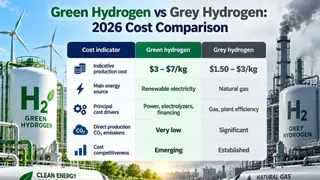
Green hydrogen production in 2026 is estimated at roughly $3–$7 per kilogram, while grey hydrogen costs about $1.50–$3 per kilogram in favorable cases. China may approach cost parity by 2030, but India, Europe and other regions are expected to need more time, funding and policy support. Electricity prices are the largest variable, with lower renewable power costs narrowing the gap.
Green hydrogen is produced by using renewable power to split water through electrolysis, while grey hydrogen comes from natural gas via steam methane reforming without capturing emissions. The 2026 figures are illustrative project estimates rather than market-wide averages; the gap narrows where renewable electricity is cheap and gas is expensive.
Electricity dominates variable cost: an electrolyzer using 52 kWh per kilogram pays about $1.04/kg at $20/MWh and $3.12/kg at $60/MWh, before capital, financing, upkeep, water and storage. A 10,000-tonne plant could save roughly $10.4 million yearly if power prices halve from $40 to $20/MWh.
If parity arrives, heavy industrial users such as refineries, fertilizer and chemical producers could see lower long-run fuel bills, and regions with cheap renewables may attract new plants and jobs. China's manufacturing scale may give it an early edge, while India, Europe and others could depend on continued policy support and investment. Cheaper green hydrogen might also reduce emissions tied to conventional production, though outcomes hinge on electricity prices, utilization and financing rather than technology alone.