Five Countries Vying for Cheap Green Hydrogen in 2026
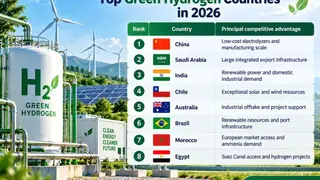
China, Saudi Arabia, India, Chile and Australia are among the strongest contenders for low-cost green hydrogen in 2026. China’s advantage comes from inexpensive electrolyzers and manufacturing scale, Saudi Arabia is building a major export project, and India is creating domestic demand in refining, fertilizer and steel. The IEA sees committed low-emissions hydrogen output potentially reaching 4.3 million tonnes a year by 2030.
China’s edge rests partly on far cheaper alkaline electrolyzers: roughly $500–$1,100 per kW domestically in 2025, versus $1,900–$2,500 elsewhere. Its manufacturing capacity near 35 GW far exceeds domestic demand below 2 GW. Sinopec’s Kuqa plant targets 20,000 tonnes yearly, with a planned Inner Mongolia project at 100,000 tonnes.
Saudi Arabia’s NEOM venture, about $8.4 billion, pairs up to 4 GW of renewables with electrolysis and ammonia output. It aims for as much as 600 tonnes of hydrogen daily and 1.2 million tonnes of green ammonia yearly, with first product expected in 2027. The IEA sees committed low-emissions hydrogen reaching 4.3 million tonnes annually by 2030.
Lower-cost green hydrogen could affect refinery, fertilizer and steel workers, plus communities near large renewable and electrolysis projects. If projects scale, it may create construction and operations jobs, alter energy trade flows, and influence prices for ammonia and industrial inputs. Importing nations might gain diversified supply, while host regions may face land, water, and grid pressures. Whether benefits spread widely may depend on project design, local infrastructure, and demand growth.