Amber Fossil Reveals Ancient Lizard's Tail-Shedding Defense
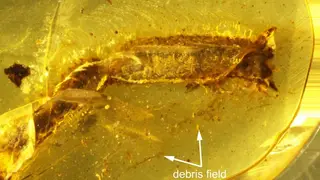
A fossilized lizard tail preserved in mid-Cretaceous amber from Myanmar retains skin and muscle tissue. The find offers direct evidence that lizards were already shedding their tails to escape predators roughly 99 million years ago. The specimen is kept in a public research collection at the Steinhardt Museum of Natural History, Tel Aviv University.
The amber came from a mine in Myanmar’s Hukawng valley, Kachin state. Researchers used X-ray micro-computed tomography to inspect the tail and compare it with tails from living skinks and lizards. The scans revealed a ring of muscle around the break, arranged like a rosette or wedge—a pattern seen when modern lizards contract muscles to deliberately drop a tail.
The tail likely belonged to a monitor-lizard relative or a lacertid, the group containing European wall lizards. The team proposed two ways it could have become trapped: a tree-dwelling lizard stuck in resin escaped by shedding its tail, or a predator grabbed the lizard, which lost the tail during the struggle and it fell onto the sticky surface.
Count: first paragraph 56? Let's count. "The amber came from a mine in Myanmar’s Hukawng valley, Kachin state. Researchers used X-ray micro-computed tomography to inspect the tail and compare it with tails from living skinks and lizards. The scans revealed a ring of muscle around the break, arranged like a rosette or wedge—a pattern seen when modern lizards contract muscles to deliberately drop a tail." Count: The1 amber2 came3 from4 a5 mine6 in7 Myanmar’s8 Hukawng9 valley10 Kachin11 state12. Researchers13 used14 X-ray15 micro-computed16 tomography17 to18 inspect19 the20 tail21 and22 compare23 it24 with25 tails26 from27 living28 skinks29 and30 lizards31. The32 scans33 revealed34 a35 ring36 of37 muscle38 around39 the40 break41 arranged42 like43 a44 rosette45 or46 wedge47 a48
This discovery could draw attention from paleontologists, evolutionary biologists, and researchers studying tissue regeneration, while museum visitors may gain a tangible view of ancient behavior. It may encourage further study of amber as a record of actions, not just anatomy. Possible long-term effects on biomimetic technology or regenerative medicine remain speculative. The specimen’s public collection status could also reinforce the value of accessible research holdings and documented acquisition, though its broader societal impact is likely modest. Count: This1 discovery2 could3 draw4 attention5 from6 paleontologists7 evolutionary8 biologists9 and10 researchers11 studying12 tissue13 regeneration14 while15 museum16 visitors17 may18 gain19 a20 tangible21 view22 of23 ancient24 behavior25. It26 may27 encourage28 further29 study30 of31 amber32 as33 a34 record35 of36 actions37 not38 just39 anatomy40. Possible41 long-term42 effects43 on44 biomimetic45 technology46 or47 regenerative48 me