Century-Old Museum Fossil Reveals New Dinosaur Species
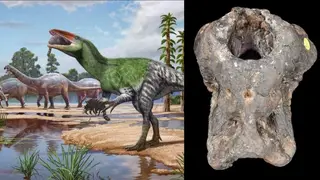
Researchers identified a new dinosaur species from a fossil found more than 100 years ago on the Isle of Wight. The specimen had been stored at the Natural History Museum in London among roughly 1,000 unstudied fossils. Using CT scanning and 3D modeling, paleontologists reconstructed the carnivorous dinosaur, which lived about 120 million years ago and was around human height.
The fossil was found more than a century ago on the Isle of Wight by amateur paleontologist Reginald Walter Tooley. After he died, it arrived at London’s Natural History Museum in 1924 among about 1,000 unstudied specimens, then stayed in a drawer for roughly 100 years.
Cassius Morrison and student Charlie Scherer of UCL Earth Sciences reexamined it using CT scanning and 3D modeling. Their peer-reviewed paper appeared in Royal Society Open Science on October 14, 2026. The dinosaur, Invictibellatrix amberina, was about human height, bipedal, meat-eating, likely feathered, and used clawed arms against smaller prey. Its name references Wessex Formation amber and suggests an undefeated female fighter.
This discovery may encourage museums to revisit overlooked specimens, potentially yielding new finds without new fieldwork. It could affect paleontologists, curators, and students by showing the value of CT scanning and 3D modeling in old collections. The public may gain another example of how museum storage can preserve scientific surprises, possibly boosting interest in paleontology and local fossil heritage on the Isle of Wight.