AI Helps Telcos Predict Network Faults and Cut Repair Costs
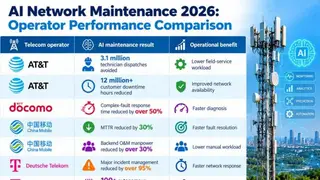
Telecom operators are using artificial intelligence to anticipate network failures, automate fault diagnosis and reduce maintenance costs. AT&T avoided 3.1 million technician dispatches and cut customer downtime by more than 12 million hours, while NTT DOCOMO reduced complex-fault response time by over 50% and China Mobile lowered mean time to repair by 30%. Deutsche Telekom's autonomous AI agents brought incident management down from hours to about one minute.
AT&T’s incident platform uses several AI methods—predictive models, generative tools and network analysis—and draws on about 10 petabytes of data plus more than 30 models to distinguish actual faults from cases that can be handled remotely. NTT DOCOMO’s commercial system, introduced in February 2026, reviews traffic and alarms from over one million devices; multiple agents share topology information to link alerts and shorten diagnosis.
China Mobile reported a 30% lower mean repair time, while Deutsche Telekom showed autonomous agents cutting incident handling from hours to about a minute. The operators’ figures come from different networks, periods and definitions, so they should not be treated as directly comparable savings.
If these tools work as reported, they could affect millions of telecom customers by reducing outages and wait times, while field technicians may see fewer unnecessary callouts and more remote diagnostic work. Operators may redirect maintenance resources toward complex faults, though reliance on AI