Large Biobank Study Maps Typical Human Genetic Variation
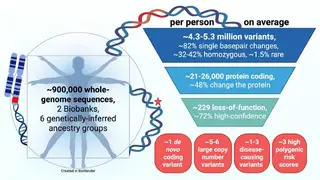
A study using whole-genome data from almost 900,000 adults in UK Biobank and All of Us describes the range of variation found in a typical human genome. It reports that an individual usually differs from the reference sequence at 4.3–5.3 million positions, with only a small fraction of those variants being rare and most falling outside genes. The work also notes about one million additional variants among people of African ancestry, partly reflecting the European-skewed reference genome, and estimates roughly 61 new mutations per person at birth.
The analysis pooled whole-genome sequences from UK Biobank and All of Us, covering close to 900,000 adults. It found that a typical genome differs from the reference at 4.3–5.3 million sites; only about 1.5% of these differences are rare, and most sit outside genes.
People of African ancestry averaged around one million more variants, a gap partly tied to a reference sequence built largely from European-ancestry donors. Using parent-child trios, researchers estimated about 61 new mutations at birth, with most traced new mutations coming from fathers.
These findings may help clinicians and patients interpret genomic tests by showing that many variants are normal and that disease-linked findings need context. Genetic screening programs could use such baselines to reduce false alarms, though ancestry-related gaps may affect equity if reference data remain skewed. People receiving risk scores or carrier results may benefit from clearer counseling, but scores developed mainly in Europeans may be less informative for others.