Astronomers Find Statistical Support for Kicked Black Holes
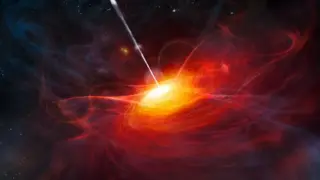
A new study reports statistical evidence that some supermassive black holes are knocked away from galactic centers after uneven gravitational-wave emission during mergers. These remnants are expected to oscillate back and forth through the core rather than remain fixed. The research uses active galactic nuclei data to test predictions for this recoil motion.
The study shifts from individual candidate black holes to a population test. Using about 100,000 quasars from the Sloan Digital Sky Survey’s 16th data release, researchers looked for a statistical link between dust obscuration and how far broad emission lines are shifted in velocity relative to the host galaxy.
Theory predicts a kicked remnant can keep part of its inner accretion disk and stay active for 10 million to 100 million years, appearing as a quasar. Its speed changes along the oscillation, peaking near the galactic center and slowing at the swing’s far end. Future millihertz gravitational-wave observations with LISA could help test merger predictions.
This result may mainly affect astronomers and students by refining how merger models and quasar surveys are interpreted, and it could shape planning for future gravitational-wave missions. For the public, it may offer a clearer picture of how galaxies and black holes evolve, though practical daily impacts are unlikely in the near term.