Hubble Finds Supernova Winds Blocked Radiation, Challenging Cosmic Reionization Theory
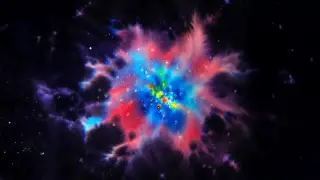
New Hubble observations reveal that powerful winds from exploding stars may have hindered rather than helped the escape of ultraviolet radiation during the early universe's reionization. This contradicts long-held assumptions and suggests that other mechanisms may have been responsible for clearing the cosmic fog of neutral hydrogen. The findings reshape understanding of how the universe became transparent to light.
In October 2026, astronomers using NASA’s Hubble Space Telescope made a pivotal discovery that upends a long-standing theory about cosmic reionization, the process by which the early universe transitioned from opaque to transparent. The study, led by Cody Carr of the University of Michigan and conducted while he was at Zhejiang University in China, analyzed nearby starburst galaxies—modern analogs of early galaxies—to examine how ultraviolet radiation escapes. Contrary to prior assumptions that supernova-driven galactic winds cleared paths for ionizing radiation, Hubble data revealed that stronger winds correlate with reduced escape of ionizing photons. This finding, published in Nature Astronomy, suggests that the very forces once thought to aid reionization may instead have hindered it. The observations focused on spectral signatures showing gas motion and absorption patterns, allowing researchers to infer wind speeds and their impact on radiation leakage. These results challenge decades of modeling that assumed supernova winds were instrumental in enabling radiation escape during the epoch 13 billion years ago.
The background for this shift lies in the enduring mystery of reionization: while scientists agree it occurred, they have debated which sources—early stars, galaxies, or quasars—provided the necessary ionizing radiation and how it escaped dense interstellar gas. For years, supernova winds were considered a key mechanism for clearing escape routes. Now, with Hubble’
This discovery could reshape how astrophysics textbooks frame one of the universe’s most critical transitions, influencing both public understanding and academic curricula. If supernova winds impede rather than aid radiation escape, it shifts focus toward alternative mechanisms—such as early star formation dynamics or direct photon leakage before stellar death—which may require rethinking simulations used in cosmology. Institutions funding space research, including NASA and ESA, may adjust future mission priorities to better probe radiation escape in high-redshift galaxies. The broader impact extends to public interest in space science: revelations like this reinforce the idea that cosmic history is more complex than previously thought, potentially boosting engagement with astronomy and STEM education. A comparable precedent is the 1998 discovery of dark energy, which similarly overturned established models and redirected decades of research. What may follow is a renewed emphasis on ea