Researchers Discover Long-Sought Trojans Orbiting Neptune
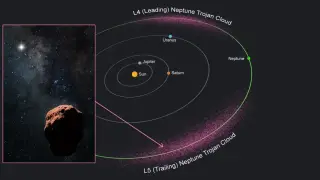
An international team led by Queen’s University Belfast has identified two confirmed and one candidate asteroid in Neptune’s trailing Trojan population, solving a decades-long mystery in solar system dynamics. The discovery was made using data from the Vera C. Rubin Observatory’s LSST survey, which enables high-resolution, wide-field sky monitoring. These findings help clarify how giant planets like Neptune influenced early solar system formation and migration.
In October 2026, an international team led by Dr. Meg Schwamb from Queen’s University Belfast (QUB) announced the discovery of two confirmed and one candidate asteroid in Neptune’s trailing Trojan population—resolving a decades-long gap in solar system dynamics research. These objects were identified using early data from the Vera C. Rubin Observatory’s Legacy Survey of Space and Time (LSST), which began operations in June 2025 atop Chile’s Cerro Pachón. The observatory’s 8.4-meter Simony Survey Telescope and the world’s largest digital camera enabled high-resolution, wide-field sky monitoring, allowing the team to detect faint, distant bodies previously obscured by the dense light of the Milky Way’s center. Prior to this, while Trojans had been found orbiting Jupiter, Saturn, and Uranus since 1906, Neptune’s elusive trailing population remained undetected due to observational challenges. The breakthrough came as the trailing cloud moved out of the obstructive galactic plane, coinciding with Rubin’s unprecedented sensitivity and sky coverage. The team’s findings, published in *The Astrophysical Journal Letters*, confirm that Neptune’s Trojans share similar surface properties with those leading the planet, suggesting a common origin.
The research involved collaboration across institutions including the Instituto de Astronomia, Geofísica e Ciências Atmosféricas (IAG), the Planetary Science Institute (PSI), DiRAC Institute, MIDAS at the University of Michigan, JHUAPL, and NOI
This discovery could significantly reshape how scientists model the early evolution of the solar system, particularly the role of giant planet migration in shaping small-body distributions. By confirming Neptune’s trailing Trojans, researchers gain a new window into the conditions of the outer solar system during its formative period—potentially validating or refining theories about planetary migration and gravitational capture. The impact may ripple through academic institutions and space agencies that rely on such data for mission planning and theoretical modeling. Comparable to the 1906 discovery of Jupiter’s Trojans, which revolutionized understanding of orbital stability and dynamical systems, this finding may inspire new observational strategies and funding priorities for deep-space surveys. Institutions like NASA and ESA may adjust future missions to target Trojan populations more systematically. Looking ahead, the continued LSST survey could reveal patterns in distribution that