Vera Rubin Observatory Unveils Two New Faint Satellites in Our Galaxy's Halo
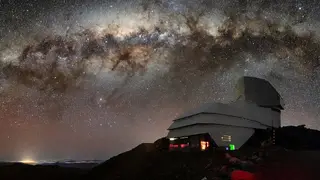
The Vera Rubin Observatory has identified two previously undetected faint satellites orbiting the Milky Way: an ultra-faint dwarf galaxy named Aquarius IV and a globular cluster called Rubin-GC1. These discoveries, made using early data from the observatory’s survey, offer new clues about how large galaxies like ours grow through mergers with smaller systems. The findings enhance our understanding of dark matter's role in galactic evolution.
In July 2026, the Vera C. Rubin Observatory in Chile announced the discovery of two previously undetected faint satellites orbiting the Milky Way using data from its Early Data Preview 2 (EDP2). One is an ultra-faint dwarf galaxy named Aquarius IV (Rubin J2201−0234), identified through its ancient, low-metallicity stellar population and compact structure in the outer Galactic halo. The other, Rubin-GC1 (Rubin J1628−1735), is a globular cluster with an intermediate age of about 9.2 billion years and moderate metallicity, likely accreted from the Sagittarius dwarf spheroidal galaxy’s leading tidal arm. These discoveries were made possible by the observatory’s unprecedented sensitivity to faint objects, even in crowded regions like the Milky Way’s dusty bulge. The findings are detailed in two peer-reviewed papers—one published in Research Notes of the American Astronomical Society and the other accepted by The Astrophysical Journal Letters—led by Yale graduate student William Cerny and University of Chicago graduate student Aashay Pai, respectively.
These discoveries build on decades of theoretical work suggesting that large galaxies grow through hierarchical merging with smaller systems. While over 60 dwarf satellite galaxies and 40 globular clusters have been cataloged around the Milky Way, astronomers believe many more remain hidden due to their extreme faintness. The Rubin Observatory’s full 10-year survey—set to begin in earnest after EDP2—is expected to dramatically incre
The discovery of Aquarius IV and Rubin-GC1 could deepen public fascination with space exploration by revealing how much remains unknown about our own galaxy. As one of the most visible scientific endeavors of the 21st century, the Vera C. Rubin Observatory’s early findings may inspire renewed interest in astronomy education and citizen science initiatives, particularly as data becomes more accessible. The project’s success could also influence funding trajectories for large-scale observational infrastructure, potentially accelerating similar surveys elsewhere. Comparable to the Hubble Space Telescope’s transformative impact in the 1990s—when it revealed distant galaxies and reshaped cosmology—the Rubin Observatory may soon become a cornerstone of astrophysical research, shifting how scientists study dark matter and galactic evolution. Institutions like universities and national labs involved in the project may see increased collaboration and data-sharing opportunities. The role of gra