Ancient Star Cluster May Be Oldest Known in the Milky Way
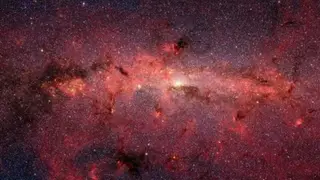
A newly analyzed star cluster named VVV CL001, located near the galactic center, may be as old as 13.4 billion years—nearly matching the age of the universe itself. Shrouded by dust and difficult to observe, it was first detected in 2010 and confirmed as a cluster in 2019, with its age estimated through detailed analysis of its metal-poor composition. If verified, it could offer critical insights into the early formation of our galaxy.
Astronomers have identified VVV CL001, a star cluster located in the inner bulge of the Milky Way near the constellation Sagittarius, as a potential candidate for the galaxy’s oldest known stellar grouping. Estimated at 13.4 billion years old—just 400 million years younger than the universe itself—the cluster was first detected in 2010 during the VISTA Variables in the Vía Láctea (VVV) Survey and confirmed as a true cluster in 2019. Its age was determined through near-infrared imaging from the FourStar Camera on the Magellan Baade Telescope and Hubble Space Telescope data, which allowed researchers to analyze turnoff stars and horizontal-branch stars—key indicators of stellar evolution. The team, led by J. Olivares Carvajal of INAF Capodimonte Astronomical Observatory, used machine learning to distinguish cluster members from unrelated stars, identifying around 155 genuine members. The cluster lies approximately 7.34 kiloparsecs (24,000 light-years) from Earth and is notable for its metal-poor composition, a hallmark of ancient stellar populations. This discovery builds on prior work identifying metal-deficient globular clusters as relics of early galaxy formation, but VVV CL001 stands out due to its extreme age and location in the galactic center. The research was published as a preprint on arXiv on October 20 and accepted for publication in Astronomy & Astrophysics.
The study’s implications are profound: if confirmed, VVV CL001 could challenge current models of galaxy fo
If confirmed, VVV CL001 could reshape our understanding of the Milky Way’s origins, potentially shifting timelines for when the first stars and galaxies emerged. This would affect cosmological models that rely on precise age estimates for stellar populations to calibrate the universe’s expansion history. The discovery may influence funding priorities in astrophysics, encouraging investment in deep-sky surveys and infrared observatories capable of penetrating dusty galactic centers. Institutions like NASA, ESA, and major observatories with access to Hubble or future telescopes could see increased support for projects targeting ancient stellar systems. A comparable precedent is the 2017 discovery of Earendel, a star from the early universe, which similarly sparked debate about the limits of observable cosmic history. In both cases, technological advances enabled observations once thought impossible. The broader impact may be on public perception of humanity’s place in time and space—such