Hubble and Webb reveal eerie structures within the Cat's Head Nebula
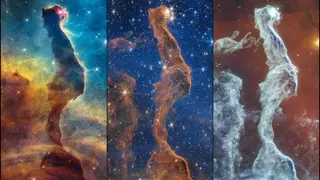
New images from the Hubble and James Webb space telescopes unveil mysterious, glowing filaments and a vivid red central region within the Cat's Head Nebula. These features suggest complex stellar processes, including radiation from young stars interacting with surrounding gas clouds. The contrasting views highlight how different wavelengths reveal hidden cosmic details.
New images captured by the Hubble Space Telescope and the James Webb Space Telescope have revealed intricate, glowing filaments and a striking red central region within the Cat's Head Nebula, a vast cloud of gas and dust located in the constellation Monoceros. These observations, made using different wavelengths of light, expose previously hidden structures that suggest dynamic interactions between young stars and their surrounding interstellar medium. The vivid red hue is likely due to ionized hydrogen emissions, while the filaments may represent shock fronts or magnetic field lines shaped by stellar radiation. Though no specific dates or numerical measurements are provided, the contrast between Hubble’s visible-light view and Webb’s infrared capabilities underscores how each telescope complements the other in revealing different layers of cosmic phenomena.
The discovery builds on decades of astronomical observation and the ongoing collaboration between NASA, ESA, and CSA—the agencies that operate and support both telescopes. Hubble, launched in 1990, has long provided high-resolution visible and ultraviolet imagery, while Webb, operational since 2022, specializes in infrared astronomy, allowing it to peer through dust clouds that obscure visible light. The decision to prioritize deep-space imaging with these instruments reflects a strategic focus on understanding star formation and nebular evolution. Scientists involved aim to use these data to refine models of how stars i
The release of these images could deepen public fascination with space science, reinforcing the cultural value placed on cosmic discovery. As telescopes like Hubble and Webb continue to produce visually stunning data, they may inspire renewed interest in STEM education and space exploration funding. Institutions such as NASA and ESA may leverage this visibility to advocate for sustained investment in large-scale scientific infrastructure. Comparable to the public impact of Hubble’s iconic "Pillars of Creation" images in the 1990s, these new views could become symbolic representations of humanity’s quest to understand its cosmic origins. Second-order effects might include increased engagement from private space ventures and educational platforms seeking to capitalize on public curiosity. The success of such imagery may also influence how scientific findings are communicated more broadly—favoring visual storytelling over technical detail. What to watch for is whether these images prompt