Multi-Wavelength Views Reveal Star-Forming Pillar in Cat’s Head Nebula
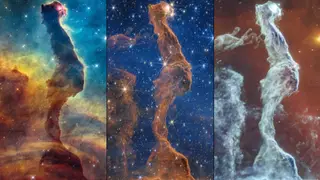
The Hubble and James Webb Space Telescopes captured detailed images of the Cat’s Head Nebula, a dusty pillar within the Carina Nebula where a young star may still be forming. Visible-light data show a dark, opaque structure sculpted by radiation from massive stars, while infrared views reveal internal structures and glowing regions likely ionized by ultraviolet light. The nebula’s shape is temporary, shaped by stellar feedback over time.
The Hubble and James Webb Space Telescopes have captured multi-wavelength images of a star-forming pillar within the Carina Nebula, nicknamed the Cat’s Head Nebula due to its feline-like shape. Located approximately 7,500 light-years away in the constellation Carina, this region features a dark, dusty pillar with a glowing red “eye” visible in infrared data—likely a young star still embedded in its natal cocoon. Hubble’s visible-light view reveals an opaque, brownish structure shaped by intense ultraviolet radiation and stellar winds from massive stars in the surrounding nebula, while Webb’s near-infrared (NIRCam) and mid-infrared (MIRI) instruments penetrate dust to expose internal structures, glowing regions, and delicate filaments. The red eye marks a site of active star formation, possibly ionized by nearby massive stars, with a bright rim suggesting ongoing photoevaporation—a process where radiation erodes surrounding material. The nebula’s shape is temporary, sculpted over time by stellar feedback, and the densest parts of the pillar are resisting erosion for now.
This observation builds on decades of astronomical study of the Carina Nebula, one of the most active star-forming regions in our galaxy, previously studied by Hubble alone. The collaboration between NASA, ESA, and CSA—organizations with long-standing investment in space-based observatories—highlights their continued commitment to multi-wavelength astrophysics. Hubble’s visible-light data provide context on s
The release of these images underscores how space telescopes like Hubble and Webb continue to shape public understanding of cosmic processes, making complex astrophysics accessible through visually striking data. The Cat’s Head Nebula’s resemblance to a cat may spark broader interest in astronomy among non-specialists, potentially boosting engagement with science education and outreach programs. Institutions like NASA and ESA benefit from such imagery by reinforcing their role in advancing fundamental knowledge while maintaining public support for expensive space missions. Comparable to the iconic “Pillars of Creation” images from Hubble in 1995—another star-forming region that captivated global audiences—this new view may similarly influence science communication, art, and even pop culture references. The broader impact could extend to private space ventures and technology development, as public fascination with deep-space imagery may encourage investment in next-generation observato