James Webb Telescope Identifies Ancient Star Clusters as Likely Birthplaces of Intermediate-Mass Black Holes
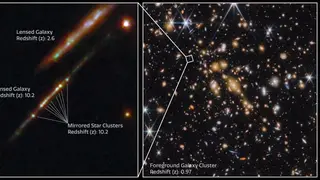
The James Webb Space Telescope has detected five dense, lensed star clusters from just 460 million years after the Big Bang, suggesting they could be the cradles of intermediate-mass black holes. These massive early clusters may have formed the seeds that evolved into today’s supermassive black holes through accretion and mergers. The findings support a long-standing theory about how the largest black holes in the universe began.
The James Webb Space Telescope (JWST) has identified five dense, gravitationally lensed star clusters in the Cosmic Gems arc, observed when the universe was just 460 million years old—around redshift z ∼ 10.2. These clusters, part of a population of young massive clusters (YMCs), have masses between 10⁵ and 10⁷ solar masses and half-mass radii of roughly 0.4 to 15 parsecs, making them exceptionally compact. A separate discovery in the Firefly Sparkle galaxy, imaged at z ∼ 8.3 (about 600 million years after the Big Bang), revealed ten YMCs with lower masses and larger radii. The Cosmic Gems clusters are particularly notable for their extreme compactness (Rh ∼ 1 pc) and low metallicity (Z ≲ 0.02 Z⊙), which reduced mass loss from stellar winds, enabling runaway collisions that could form intermediate-mass black holes (IMBHs) with masses of 1,600 to 2,700 solar masses. In contrast, the Firefly Sparkle clusters, while still capable of forming IMBHs, produced smaller seeds—between 180 and 810 solar masses—due to their more diffuse structure. These findings stem from a 2024 study led by Viola Bocchi at Sapienza University of Rome, published in Astronomy and Astrophysics, which used collision-based models and validation via N-body simulations to estimate IMBH formation efficiency at a few percent. Prior evidence for IMBHs has been sparse: a 2020 LIGO detection of a 142-solar-mass black hole from a merger provided the first direct gravitational wave signature, while Omega Centauri’s c
The discovery could reshape how astronomers understand the origins of supermassive black holes, which power quasars and shape galaxy evolution. If early massive clusters consistently produced IMBH seeds, it suggests that black hole growth began much earlier than previously thought—potentially influencing models of cosmic structure formation. This may affect how space agencies like NASA, ESA, and CSA prioritize future telescope time, possibly increasing focus on high-redshift lensed systems. The findings also strengthen the case for continued investment in gravitational wave observatories such as LIGO and future missions like LISA, which could detect IMBH mergers in the early universe. A comparable precedent is the 2019 Event Horizon Telescope image of M87*, which confirmed supermassive black hole existence and spurred renewed interest in black hole physics. Here, the impact may be more foundational: if these clusters are indeed common birthplaces for IMBHs, it could shift cosmological