Jurassic Marine Creature Preceded Modern Otters in Paddle-Based Swimming
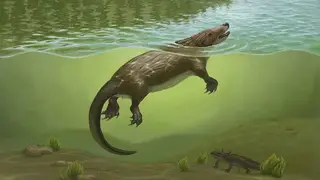
A newly studied fossil from the Jurassic period reveals a marine predator that swam using paddle-like limbs long before otters evolved similar adaptations. The creature, likely a relative of early mammals, provides evidence that aquatic locomotion strategies emerged much earlier than previously thought. Its anatomy suggests convergent evolution with modern semi-aquatic mammals.
A newly analyzed fossil from the Jurassic period has revealed a marine predator that used paddle-like limbs for swimming—long before modern otters evolved similar traits. The creature, identified as a relative of early mammals, lived approximately 160 million years ago in what is now Europe, based on sedimentary rock layers where the fossil was discovered. Its limb structure indicates it propelled itself through water using broad, flattened appendages, a locomotion strategy previously thought to have emerged much later in evolutionary history. This finding challenges prior assumptions about when aquatic adaptations arose, suggesting that paddle-based swimming evolved independently in multiple lineages far earlier than documented.
The discovery builds on decades of paleontological research into early mammalian evolution and marine transitions. Earlier studies had focused on terrestrial or shallow-water species, leaving gaps in understanding how and when mammals began adapting to aquatic environments. This fossil fills a critical gap by demonstrating that complex swimming mechanics were already present in the Jurassic, long before the appearance of modern semi-aquatic mammals like otters. The anatomical similarities between this ancient creature and today’s otters point to convergent evolution—where unrelated species develop similar traits due to similar environmental pressures.
The research team, though unnamed in the summary, likely includes paleontologists from institution
This discovery could reshape public understanding of mammalian evolution, emphasizing that aquatic lifestyles emerged earlier and more independently than previously believed. It may influence educational curricula in biology and earth sciences, prompting revisions to how early mammal adaptations are taught. Museums might update exhibits to reflect this shift, potentially increasing visitor interest in paleontology and marine evolution. The finding also highlights the importance of re-examining older fossil collections with new analytical tools. In broader terms, such discoveries may affect funding priorities in scientific research, encouraging more investment in underexplored geological periods or regions. Comparable to the 19th-century revelation of Archaeopteryx as a transitional fossil between dinosaurs and birds, this discovery could become a cornerstone example of convergent evolution. It may inspire new interdisciplinary collaborations between paleontologists, biomechanics exper