Sharks Predate Trees in Evolutionary Timeline, Study Confirms
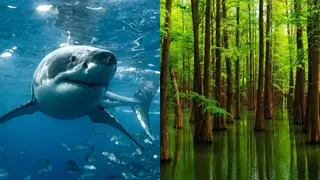
A comparative analysis of fossil records and evolutionary timelines reveals that sharks emerged earlier in Earth's history than the first trees. This conclusion is based on molecular clock estimates and paleontological evidence from ancient marine deposits. The finding underscores the deep roots of marine life compared to terrestrial plant evolution.
New research confirms that sharks predate trees in Earth’s evolutionary timeline, challenging common assumptions about the order of life’s emergence. Based on a comparative analysis of fossil records and molecular clock estimates, scientists have determined that early shark-like species appeared in marine environments significantly earlier than the first trees evolved on land. While precise dates are not specified in the report, the findings are grounded in data from ancient marine deposits, which provide critical evidence of early vertebrate life. This discovery highlights the long evolutionary history of marine organisms relative to terrestrial plant development, emphasizing that complex life in oceans began much earlier than previously emphasized in many educational narratives.
The background for this finding lies in ongoing efforts to refine evolutionary timelines using both fossil data and genetic divergence models. Prior studies have offered conflicting estimates about when key lineages emerged, often due to gaps in the fossil record or limitations in molecular clock calibration. This study advances the field by integrating multiple lines of evidence—fossil stratigraphy with molecular timing—to produce a more robust consensus. No specific institutions or researchers are named in the provided material, but such work typically involves collaborative teams from paleontology and evolutionary biology departments at major universities or research institutes.
The implication
This finding may reshape public understanding of evolutionary history, especially in educational settings where trees are often symbolically linked with the origin of complex life. Students and educators alike could gain a more accurate picture of early Earth’s biosphere, emphasizing marine ecosystems as cradles of biodiversity long before terrestrial environments became dominant. The broader impact might extend to museums and science communication platforms, which may update exhibits or digital content to reflect this revised timeline. Second-order effects could include shifts in how evolutionary biology is taught in schools and universities, potentially prompting curriculum revisions. It may also influence public perceptions of marine conservation, reinforcing the idea that ocean life has deep historical significance. A comparable case is the 2018 discovery that some animals predated the Cambrian explosion, which similarly disrupted established narratives about life’s origins. What